
The reception is the inverse of the ceremony problem. Rather than protecting a handful of quiet moments, you’re digging through hours of dark, loud, chaotic footage looking for the twenty shots that hold up. It’s where most of your runtime gets wasted and where films lose their viewer most often. Here’s how to shape it.
Editing the wedding reception: find the structure
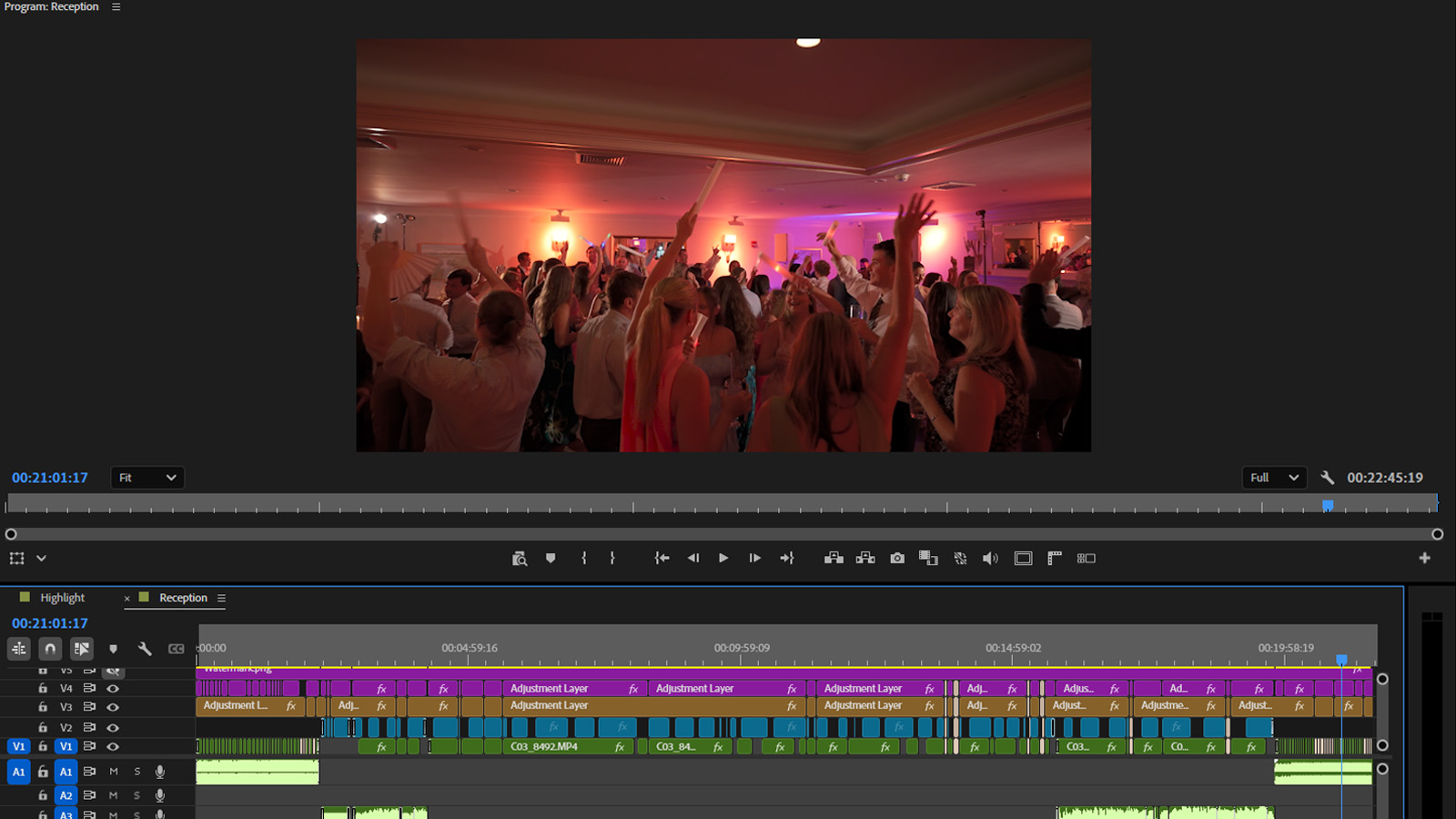
A reception isn’t one thing. It’s a run of set pieces, the entrance and first dance and speeches and cake and party, with long stretches of nothing sitting between them. Pick out the set pieces first, build each as its own block, and treat everything in between as connective tissue you trim hard. Edit the reception chronologically off a raw assembly and you’ll end up with a twelve-minute section nobody watches to the end.
Be ruthless with the dance floor
Most dance floor footage is unusable, and there’s nothing unusual about that. What you want is the handful of frames where something reads clearly: a face caught mid-laugh, a grandparent dancing, the crowd lifting on a chorus. Cut those tight against each other and the party comes alive. Use all of it and you’ve made security footage with a song over the top.
Cut to the music, not the action
The track is what carries this section. Find the beat, cut on it, tighten as the music builds. Shots can run short here, and one to two seconds is plenty once the energy is up, which is the reverse of how you cut a ceremony. Land your cuts off the beat in a party sequence and it feels wrong to viewers who’d never be able to say why.
Grading a dark room with coloured lighting
Uplighting and moving heads will throw magenta across one frame and green across the next, and no single grade is going to fix that. Match your cameras, set a base that holds up on the neutrally lit shots, and let the coloured lighting become part of the look instead of fighting it. Protect skin with a secondary correction, and denoise before you grade rather than after. Lift the shadows first and the noise comes up right alongside them.
Live audio or a music bed?
Usually both. Live room audio carries the shouting and the band and the energy in the room, and it reads as honest. A licensed track is cleaner but can feel detached from what you’re watching. The blend that works: live audio underneath for atmosphere, music bed sitting on top, and the live track lifted for a second or two whenever the room does something worth hearing.
How long the reception should run
Ninety seconds to two minutes will cover an entire party in a highlight. In a documentary edit the set pieces run close to complete, but you still compress the dance floor, because nobody watches forty minutes of dancing, couple included. Once the reception starts running longer than the ceremony, your film has lost its balance.
The exit
Reception footage almost never has a natural ending, which is why so many films just fade out somewhere mid-party. Where there’s a send-off or a sparkler exit or a final shot of the emptied room, build toward it. Where there isn’t, finish on the strongest frame you have rather than the last one anybody shot. Films should stop. They shouldn’t run out.
The section that eats the week
Sifting hours of dark, moving footage for the shots that work is the slowest stretch of most wedding edits. It’s also the easiest stretch to hand over. The whole film comes back cut and graded from Love Story Editing. Send a project through our wedding video editing service, or choose a teaser edit, ceremony edit, or full wedding film. The work is on our video portfolio, or you can request a quote. Most of the grading above runs in Adobe Premiere Pro.
The takeaway
This whole section is an exercise in subtraction. Build your set pieces. Trim the connective tissue hard. Keep only frames that read. Cut to the music. Finish on a strong frame instead of the final one. Do that and hours of party footage turn into the two minutes that make the film feel like a celebration.